Germany's energy regulator (BNetzA) has quietly been publishing a series of orientation papers that will fundamentally reshape the economics of battery storage and solar PV. If you're investing in either asset class in Germany, these papers deserve your attention.
The Context
The BNetzA opened the AgNes process in May 2025 to redesign Germany's general electricity grid fee framework following the expiry of the StromNEV. Three orientation papers published between December 2025 and February 2026 now outline where the regulator is heading on dynamic fees, storage-specific charges, and feed-in tariffs for generators.
For BESS Investors: The Free Ride Ends in 2029
The current full grid fee exemption for storage under §118 Abs. 6 EnWG will not be extended beyond August 2029. The BNetzA is explicit that a full exemption is neither legally sustainable under EU law nor consistent with sound economic policy.
What replaces it is a two-part structure:
A financing component based on a capacity price and a working price — but with a critical modification: the working price would only apply to net consumption after netting out re-injected volumes. For pure arbitrage storage, this means the fee effectively applies only to round-trip losses.
An incentive component via dynamic, sign-correct working prices tied to congestion costs. Crucially, these are designed to generate revenue for storage when grid-serving behaviour reduces congestion — not just impose costs.
The BNetzA intends to introduce dynamic fees for storage as early as 2029, starting with grid-connected storage at high and extra-high voltage levels. The regulator explicitly sees storage as the ideal first mover given high price sensitivity, fast response capability, and existing metering infrastructure.
Grid connection cost contributions (Baukostenzuschüsse) will also apply to storage — a BGH ruling from July 2025 confirmed this.
For Solar PV Investors: A New Cost Line from 2029
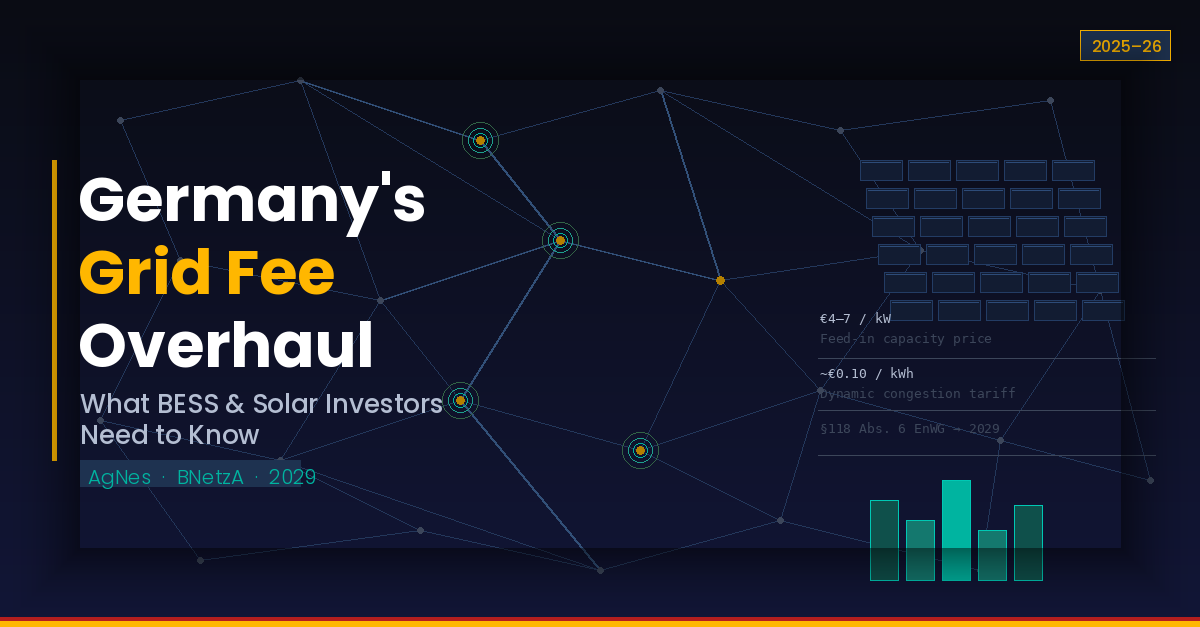
Generators currently pay no grid fees under §15 StromNEV. That changes. The BNetzA is moving toward a capacity-based feed-in tariff (€/kW), with a preliminary indicative range of €4–7 per kW, based on half of ÜNB system service and loss energy costs.
Volume-based (€/kWh) feed-in charges for financing purposes are explicitly not being pursued — a meaningful concession to industry concerns about merit-order distortion.
Dynamic feed-in fees with an incentive function are also planned for 2029. Based on a simple calculation using 2024 data, the BNetzA illustrates a dynamic tariff of approximately €0.10/kWh for congestion-relevant volumes.
Grandfathering: Projects backed by state-run EEG auctions are likely to receive transitional protection, with the precise cut-off still under discussion. The publication of this orientation paper itself is floated as a potential boundary point.
Bottom Line
The direction is clear: 2029 marks the end of the current fee-free environment for both storage and generators. BESS projects retain meaningful upside through dynamic fee revenues if designed for grid responsiveness. Solar developers should model the €4–7/kW capacity charge into forward-looking project economics now.