renewables

Germany's Grid Fee Overhaul: What BESS and Solar Investors Need to Know

Germany's energy regulator (BNetzA) has quietly been publishing a series of orientation papers that will fundamentally reshape the economics of battery storage and solar PV. If you're investing in either asset class in Germany, these papers deserve your attention.

The Context

The BNetzA opened the AgNes process in May 2025 to redesign Germany's general electricity grid fee framework following the expiry of the StromNEV. Three orientation papers published between December 2025 and February 2026 now outline where the regulator is heading on dynamic fees, storage-specific charges, and feed-in tariffs for generators.

For BESS Investors: The Free Ride Ends in 2029

The current full grid fee exemption for storage under §118 Abs. 6 EnWG will not be extended beyond August 2029. The BNetzA is explicit that a full exemption is neither legally sustainable under EU law nor consistent with sound economic policy.

What replaces it is a two-part structure:

  • A financing component based on a capacity price and a working price — but with a critical modification: the working price would only apply to net consumption after netting out re-injected volumes. For pure arbitrage storage, this means the fee effectively applies only to round-trip losses.

  • An incentive component via dynamic, sign-correct working prices tied to congestion costs. Crucially, these are designed to generate revenue for storage when grid-serving behaviour reduces congestion — not just impose costs.

The BNetzA intends to introduce dynamic fees for storage as early as 2029, starting with grid-connected storage at high and extra-high voltage levels. The regulator explicitly sees storage as the ideal first mover given high price sensitivity, fast response capability, and existing metering infrastructure.

Grid connection cost contributions (Baukostenzuschüsse) will also apply to storage — a BGH ruling from July 2025 confirmed this.

For Solar PV Investors: A New Cost Line from 2029

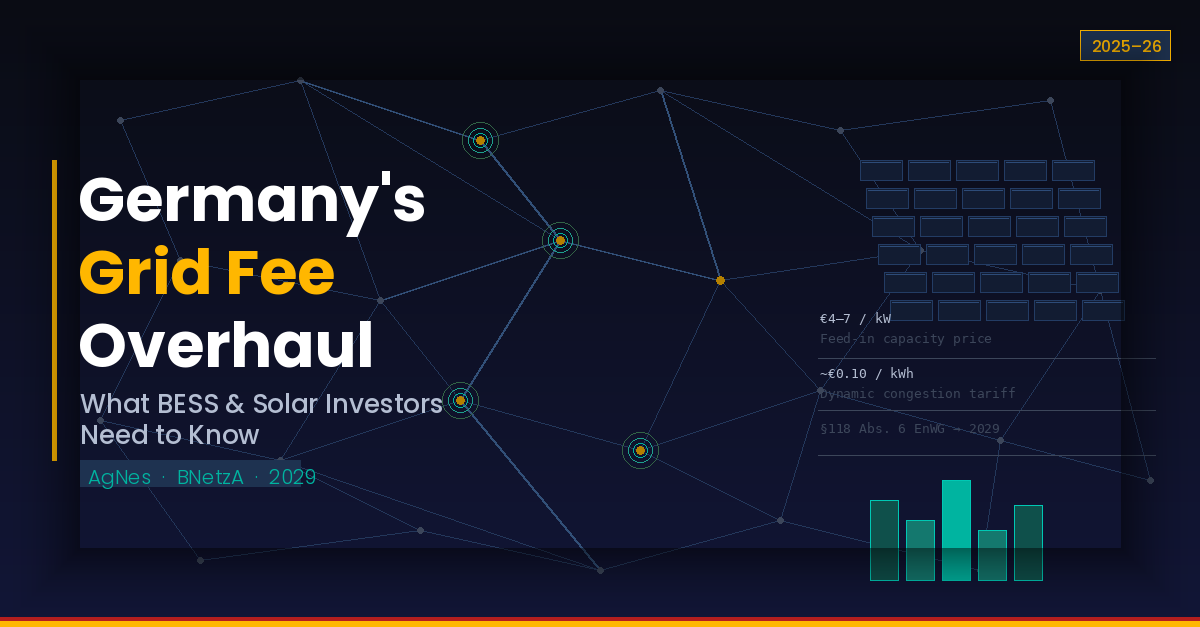
Generators currently pay no grid fees under §15 StromNEV. That changes. The BNetzA is moving toward a capacity-based feed-in tariff (€/kW), with a preliminary indicative range of €4–7 per kW, based on half of ÜNB system service and loss energy costs.

Volume-based (€/kWh) feed-in charges for financing purposes are explicitly not being pursued — a meaningful concession to industry concerns about merit-order distortion.

Dynamic feed-in fees with an incentive function are also planned for 2029. Based on a simple calculation using 2024 data, the BNetzA illustrates a dynamic tariff of approximately €0.10/kWh for congestion-relevant volumes.

Grandfathering: Projects backed by state-run EEG auctions are likely to receive transitional protection, with the precise cut-off still under discussion. The publication of this orientation paper itself is floated as a potential boundary point.

Bottom Line

The direction is clear: 2029 marks the end of the current fee-free environment for both storage and generators. BESS projects retain meaningful upside through dynamic fee revenues if designed for grid responsiveness. Solar developers should model the €4–7/kW capacity charge into forward-looking project economics now.

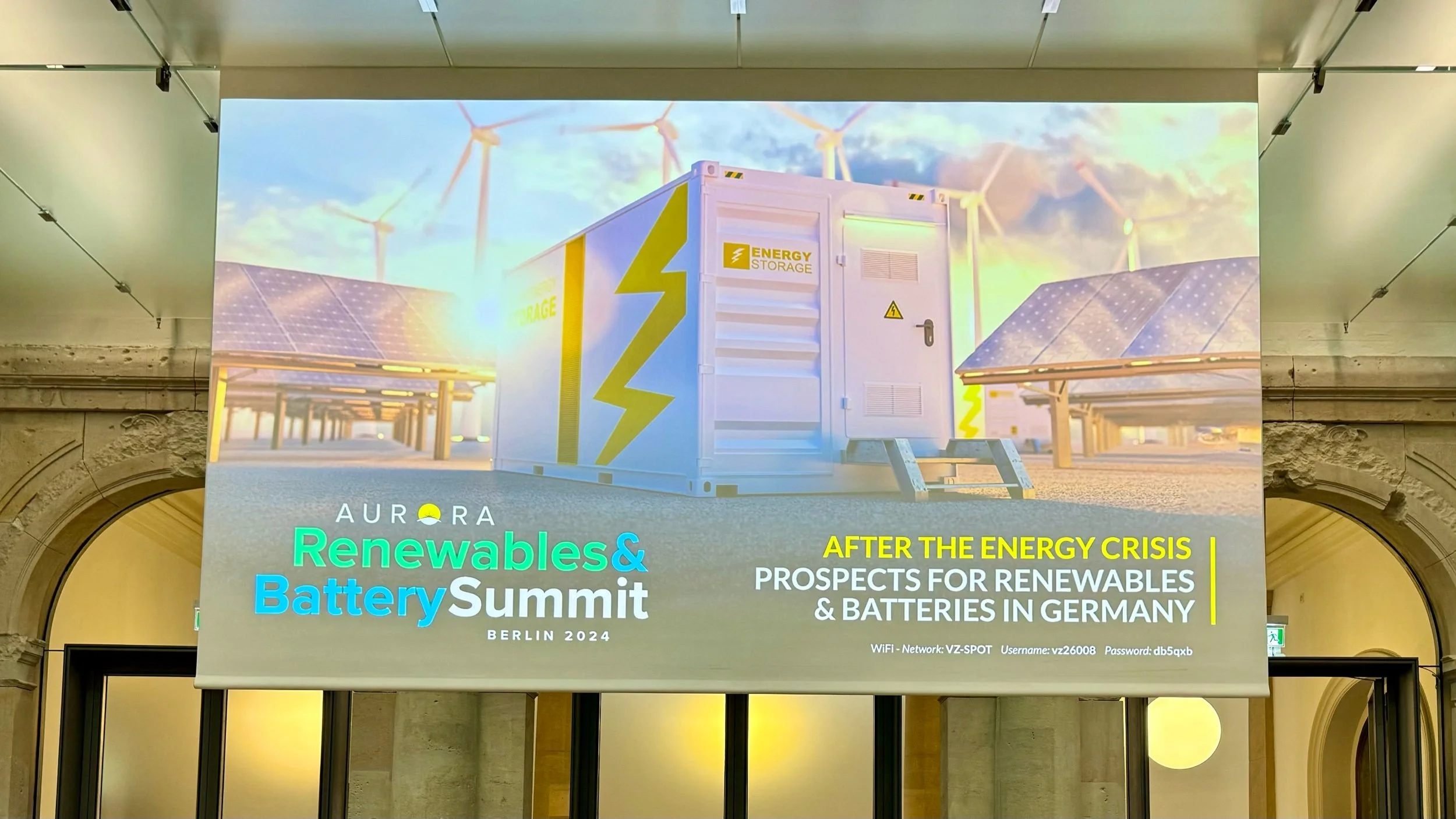
Aurora 2024 Renewables & Batteries Summit in Berlin

TLDR:

  • The German government is focusing on building out the grid to avoid having to split Germany into different price zones.

  • Battery storage will not receive subsidies from the German government.

  • More updates regarding the planned capacity mechanism will be published this summer.

  • CfDs are needed to reach capacity targets, as PPA prices are too low.

Annual conference about the German Market

Aurora’s annual conference about the state and future of the German Energy Transition took place on 28.05.2025. It included a keynote by the undersecretary Dr. Nimmermann about the strategy of the German government, as well as presentations by Aurora and panel discussions.

Keynote by the permanent secretary

The focus of the German government is on grid/system stability and energy security through:

  • building out the grid,

  • keeping a fleet of gas-fired powerplants that can be converted to hydrogen use and

  • speeding up the permitting and grid connection process

A conference with KfW is planned for July in Frankfurt to discuss with private capital providers what the right framework should be to attract private investment for the build-out and modernisation of the German electricity infrastructure.

Further details about the upcoming capacity mechanism will be published this summer. But no decision has been made so far on whether it will be a capacity market or some form of hedging mechanism.

The government wants to avoid having to split Germany into different price zones and is considering some form of additional grid charges to send locational price signals.

Battery storage deployment is working well and, therefore, doesn’t need government subsidies and is not included in the government’s long-term supply and demand modelling.

The current EEG subsidy tender system must be replaced by a two-way CfD mechanism to comply with EU regulations.

More demand and supply flexibility is needed to ensure system stability, and renewable energy asset owners need to accept curtailment as part of their business case.

Keynote: Rentability of PPA and merchant solar PV

New solar PV projects in Germany that plan to sell their electricity on a merchant basis or via a PPA are currently not profitable if your cost of capital is higher than 5%. This is not forecasted to change until 2036 at the earliest. PPAs will, therefore, remain a niche product that only a few project owners will choose.

To reach the capacity increase targets, the government will instead rely on CfDs, and capacity limitations have been ruled out so far, unlike in the UK.

Government-backed CfDs are less risky than PPAs, and this will lower the cost of capital for renewable energy investments.

Panel Discussion: State of the Energy Transition

The panel broadly agreed that investors and lenders see three critical topics in Germany:

  1. PPAs are a niche product and not financially attractive. The EEG and CfDs will drive the capacity build-out.

  2. If the government wants to avoid introducing different price zones, the transmission network needs to be expanded, and some form of locational pricing needs to be introduced through grid charges.

  3. Germany has a long way to go to encourage demand flexibility. However, supply flexibility is also needed, which will be achieved through more storage capacity and more frequent curtailment of renewable energy generators. This will reduce the frequency of hours with negative electricity prices, but there will be more hours with near-zero prices.

Keynote: co-location in Germany

Whilst co-location would be a logical choice for the German electricity market with its increasing number of hours with negative prices, the current regulations don’t allow for a profitable business model.

Co-located batteries that receive subsidies are only allowed to be charged from the connected renewable energy generator. This will change in 2026, but the government hasn’t published the details yet.

This situation frustrates investors as other countries have more straightforward metering concepts and are more flexible on how the battery is charged.

Panel discussion: Does co-location make sense

The panel mirrored the keynote by expressing frustration around the co-location regulation and that the business case doesn’t work in Germany.

An interesting assessment from one panellist was BESS developers shouldn’t pin too much hope on the future capacity mechanism, as gas-fired power plants tend to win most contracts in other European markets.